Saturday, November 28, 2015

harley davidson in new delhi


Harley owners meet at the 4th northern H.O.G. rally in New Delhi and Chandigarh
November 27, 2015 05:25 PM | By BikeWale Team


To celebrate their passion for riding, more than 400 Harley owners from across India participated in a unique H.O.G. ride on November 21st from New Delhi to Chandigarh. It was described by Harley as the largest zonal rally so far.

The H.O.G. rallies that are conducted during the riding season from September to March every year, focus on offering great experiences in different terrains to riders across the country. For this rally, Harley owners from as far as Kochi and Bangalore rode in on their Harley-Davidson motorcycles to bond with other owners.

The element of customisation  and personalisation  is central to the Harley ownership experience. Standing true to this is the signature Custom contest, which gave riders an opportunity to show off their passion and creativity through their motorcycles. Mahendra Jain, Aditya Auluck and  Yaduveer Thakur managed to steal the show with their Harley-Davidson Super Low, Street Bob and Fat Boy motorcycles.

Mr. Harpreet Singh Khurmi, Chapter Director, Capital Harley-Davidson India said, “It was great to see Harley owners come together from all over the country for the 4th Northern H.O.G. Rally. We are thrilled to have hosted this particular edition, and our overwhelmed by the response we received.”

Monday, November 9, 2015

12 Easy Tips To Increase Your Car Mileage

12 Easy Tips To Increase Your Car Mileage

In the days ever rising fuel prices, the fuel bills are digging deep into the pockets of a common man. I’m going to share some practices which can get you more miles out of your fuel by increasing the fuel average or fuel mileage of your car.
Tips To Increase Your Car Mileage

Tip 1: Do not accelerate too fast

Too quick acceleration consumes too much fuel, accelerate slowly and gradually. That will save quite a significant amount of fuel in city driving.

Tip 2: Do not use clutch too much (Stick Shift Only)

If you use a manual transmission car, as is mostly used by people in India, do-not drive with clutch pressed, or use clutch only when needed, too much use of clutch will waste a lot of fuel.

Tip 3: Change gears appropriately (Stick Shify Only)

This is also applicable for manual transmission cars. Use correct gears at correct speeds, this will help save the fuel. For correct speeds, see your car’s user manual.

Tip 4: No Excuses to delay car service

Get the car serviced as per manufacturer’s recommended schedule. This will ensure good health of engine, less maintenance due to break-down.

Tip 5: Do you drive in dusty environment? Clean the Air-filter

If you drive in dusty environment the air-filter gets filled with dust and makes the engine suffocated. Clean the air-filter more often than the service schedule( say  every 5000 KM or so) , this will help the engine run more easy and consume less fuel. Trust me, its going to really help.

Tip 6: Red-Signal Ahead? Put the feet off the accelerator

If you are sure that you got to stop after next 100 or 200 meters due to a red signal, keep your feet off the accelerator and car will slow down on engine’s resistance, saving on fuel as well as the brake shoes, apply brakes only when about to stop. This is a great help to save that extra drop of fuel.

Tip 7: Air Pressure in tyres

Get the air-pressure in tyres up to the recommended pressure, and check it once at least in 15 days, it helps the car run smooth and drink less fuel.

Tip 8: Try to keep a constant max speed

When driving in a city or highway, try to maintain a constant speed, that will help the engine put less effort to accelerate or decelerate unnecessarily. This will help reduce fuel consumption.

Tip 9: Keep the window’s glass rolled up on highways

Driving with AC on and glasses rolled up will actually help the car move easy because when windows are open, the car faces more air-drag due to cross ventilation through car, thus consuming more fuel. So always try to keep windows rolled up specially when driving at high speeds.

Tip 10: Buy fuel during morning hours

Buying fuel during morning hours makes sense, because the fuel is a liquid and cools during night hours as temperature is low, and it becomes more dense, so in night hours, you get more weight of fuel for same litres, so its like a bargain in fuel amount :)

Tip 11: Re-fuel your car when tank is close to half

This will help reduce the vapors formation in tank, which moves out as you open the lid to re-fuel, thus saving some amount of fuel in the tank.

Tip 12: Clean up the crap from the boot-space

Remove any un-necessary luggage or stuff that you don’t need from back space, that will let the car feel light and run easy on less fuel.
Save fuel, burn it less, save economy and environment both, for a greener and cleaner tomorrow.
Also try to follow a car pool if you are traveling to office or college, that is fun to be with some friends and it reduces traveling boredom too :)

11 Useful Tips To Test Drive A Car At Car Dealer

11 Useful Tips To Test Drive A Car At Car Dealer


Tips For A Good Test Drive and Observations

Here is a list of points to note and some tips for a test drive:

Take Out Ample Time

Don’t go for a test drive in rush and hurry, take out ample time so that you can patiently observe a car’s characteristics and test is properly. Usually a test drive in hurry won’t give your enough taste of the real experience. We think you should take out at least 30 minutes to 1 hour for complete test drive as it also important to see the car from exteriors, interiors along with a thorough drive. Ideally you should go in non-peak hours to avoid too much traffic during the drive and its better if it’s a warm sunny day so that you can check the air-conditioning properly.

Take A Friend Or Family Member With You

Its usually easier to take decision when you have some good friend of family member with you who can point out the good and bad points about a car which you may miss to observe. Having a friend or two with you will help you to build and opinion better. Also, along with the opinion, you can check rear seat comfort by seating two or three adults at the same time at rear seat (ask your friends to sit at rear and give their feedback). Because rear seat comfort is also important specially in India when car buyers mostly drive with their families on weekends and long trips.

Observe Exteriors And Boot Space

Before you actually drive the car, take 5 minutes and walk around all the side of the car and observe from every angle if the car looks appealing to you. If the build and finish of the car up to your expectations, also open the boot and check if the boot space is enough for your needs and whether the boot loading gate and angle are apt for your usual luggage needs.

Observe Interiors, Plastic Quality, Seat Fabrics etc.

After you have checked the exteriors and are satisfied with it, sit at the front seat and look at the instrument cluster, dashboard, turn the knobs to see how is the plastic quality, check the seat fabric etc. Also see what are the storage options and cubby holes on the inside to keep your stuff like water bottles, cup-holders, door map pockets etc. Also observe the accessibility of all the dashboard knobs and controls from the driver seat. You should also check the door mounted controls for power windows and check their quality, accessibility and ease of use. Also check whether gear knob is at comfortable reach of your hand. Also check the features of the car which are available like steering mounted controls and other small features provided to see whether they are useful for you or not.

Test Driver, Co-passenger and Rear Seating

Then sit on the driver seat and adjust it as per your driving position and see whether you are feeling comfortable in the driving position, and if the seat height gives you enough visibility. Some cars have driver seat height adjust and steering adjust for a more precise setting, so set it up as per your driving needs and check if your feed are comfortably reaching the accelerator, brake pedals etc. without any trouble. After you set the driving seat, get down from the car and sit on the rear seat right behind the driver seat and check if the leg space ample for the rear passenger when the driver seat is properly set. If yes, its good for the rear seat comfort of your friends and family whom you would like to seat in the rear seats.
Also sit on the front passenger seat by the deriver and set the seat to a comfortable position, now check the leg space on the rear seat behind the co-passenger seat. This will help you ensure that the car has got good interior space and comfort for driver and co-passengers. Also check if the seat cushion is comfortable, and the back and under-thigh support for the driver and rear passengers is up to your expectations.

Engine Noise Vibration and Harshness Levels

While the test drive car is still at the stand still in the outdoors or on the road, start the engine, roll down the car windows and hear the engine noise levels, you should be able to hear engine noise easily. Now roll up the car windows and engine noise will reduce to a good extent. At this point, do not press the accelerator and observe if there is any vibrations (usually more pronounced at the steering wheel and gear knob), noise and harshness reaching inside the car with all the door closed and windows rolled up. Usually, these vibrations and noise are very little and acceptable in most cars at idling. If the noise it making you uncomfortable, then you should think twice before buying it. Once you check the Noise Vibration and Harshness (NVH) at the idling, press the accelerator (without putting the car in gear) just to rev up the engine to higher RPM for about 10 seconds and observe the changes in NVH levels. If its too harsh and uncomfortable, it might be a point of concern, usually noise will be high, which is quite acceptable, but the vibrations and harshness should remain under acceptable limits.

Drive And Handling Test

When you start the drive, try to take at least three  or four passengers with you on the drive, so that there is enough load on the car. If the car is able to please you with 4 or 5 adults in the car, it will please you when you ride it alone (as the load is quite less). Don’t accelerate too quick on the first go, for two reasons, first being that its most likely first time you are driving this particular type of car, so it maybe bit unsafe, second, you should try to observe how smooth and silent the car is if you pick it up gently. Once you reach outdoor, stop the car, turn on the air conditioning, wait for a few seconds and pick up the car again. This time, the power delivery will be slightly reduced as air-conditioning puts additional load on the engine, also you should observe how effectively the car is cooled on a hot day. During all these observations, you should keep a watch on the NVH levels, if the car becomes too noisy or harsh under load or certain conditions.
Once you check the smoothness of the car, take the car to a less congested road and accelerate a bit harder to see how agile the car is (try it on a straight stretch for better judgment). Also go on a curvy road or a round about to see how well the car steers, and how much does the car’s body tilt towards one side when you turn at some speed (this is called body roll, which should not be too high). To test the brakes, go up to a non-congested road, speed up to 40 to 50 KMPH and try to sop suddenly (NOTE – MAKE SURE THERE IS NO VEHICLE BEHIND YOU). Also one of the most important factors is that if you feel comfortable when you are test driving that car.
Suspension is also one of the key factors. If possible take the car to a not-so-good road (which are not difficult to find in India), and observe how well the car drives on such road. Whether it is able to absorb the bumps while keeping the car stable. Try not to drive fast on bad road as it maybe dangerous (a speed of up to 30 KMPH is enough to test the suspension on a bad road.)

Test Drive Rival Cars Also

As car buyers, we research a lot before shortlisting a car, but it is always wise to test drive a rival or successfully competing car from the same segment. This will help you make up your mind better and compare the differences between the car you selected and the car you have not selected.
Just a friendly reminder to all our readers, always wear seat belts when you test drive, or drive in your day-to-day life, as nothing is more precious in the world than well-being and safety of a person. Drive carefully and responsible.

How to Increase Fuel Efficiency? [10 Easy Ways]

Rising fuel prices and increasing driving distances are taking quite a heavy toll on car owners’ pockets. Going out and purchasing the most fuel-efficient car on the market isn’t enough, especially since all of the mileage figures claimed by manufacturers are achieved under a simulated driving conditions and drawing out the same mileage in real world conditions is very difficult. Also, you can’t just go out and buy a new, more fuel efficient car because that is obviously not feasible. Thankfully, there are quite a few methods and tricks to increase the fuel economy of your vehicle which aren’t all that tough to implement. In this post here, we will tell you how to increase car mileage
fuel-efficiency

1. Driving Style

Avoid unnecessary acceleration and braking. Heavy acceleration means the engine runs at greater rpms consuming more fuel. Accelerating with a moderate and smooth throttle will ensure relatively less fuel consumption. Also, accelerating hard and then braking would mean the energy consumed in the sudden acceleration will be wasted on hard braking. Try coasting as much as possible, especially in slow traffic and maintain a safe distance from the vehicle in front to avoid heavy acceleration and braking that will be required to keep up with it.

2. Tires

Monitor tyre pressure constantly and make sure it is at the level recommended by manufacturers. Most manufacturers recommend specific tyre pressure levels optimised for fuel efficiency. Getting it checked is easy and can be done at any petrol pump or filling station. A monthly check up is sufficient and if possible, should be carried out weekly. Fitting wider or bigger tires also affects fuel efficiency negatively as it will increase rolling resistance. Avoid such fitments and try sticking to the tire sizes recommended by the manufacturers.
Car-Tyres.jpg

3. Maintenance

Regular maintenance goes a long way in maintaining the fuel economy of your vehicle. Follow the regular servicing schedule provided by the manufacturer. Air filter and oil filter cleaning/replacement should be carried out at the manufacturer’s recommended schedule as these things can drastically affect fuel efficiency.
2015-hyundai-elantra-engine

4. Fuel Quality

Ensure the petrol pumps frequented by you provide good quality fuel as it is directly proportional to fuel efficiency. This not a major issue in big cities, but in remote areas the significance of ensuring good quality fuel increases. Also, stick to one fuel station to avoid mixing of fuel from different suppliers. Decide on a fuel filling station that is the most convenient for you and stick to it.
Petrol-Diesel-Price-India.jpg

5. Plan Ahead

For your daily office commute choose the best possible route. The shortest route isn’t always the most optimum as there are other factors that need to be taken into consideration such as the number of traffic lights, traffic volume, road space, etc. Try out different routes and try to get ana estimate of the distance covered, time taken and fuel consumed. Chose the preferred route accordingly. Also, when driving to a new place look it up on a map and plan out your route to avoid stopping and taking unnecessary U-turns.

6. Ignition off at Traffic Signals

If the stoppage time is more than a minute then turn off the ignition to save fuel. Most traffic signals now come with timers so it is easy to know how long you will have to stop. Most new cars come with an engine start/stop button these days which can be used to turn the car off at traffic signals.
hyundai-i20-active-start-stop-button

7. Lose Weight

Remove any unnecessary items you might be carrying around in your trunk. Some people even recommend getting rid of the spare tyre, but that might be a bit too extreme. Aftermarket fitments such as bulbars increase weight and are unnecessary additions to the vehicle.

8. Drive in Higher Gear

Driving in the highest gear possible will reduce engine rpm and, as a result, fuel consumption. Short shifting and moving up to a higher gear as soon as possible is also recommended.

9. Reduce Drag

Roll up the windows as much as possible, especially when driving at higher speeds to reduce drag. Avoid fitments such as roof rails as they increase drag and weight.

10. Use Cruise Control

This feature is slowly being provided in cars belonging to lower segments as well. Using cruise control helps save fuel as the it ensures the vehicle moves at a constant speed. Useful especially when driving out on the highways.
maruti-nexa-s-cross-cruise-control
So, what do you have to say about our story on how to increase car mileage? Do let us know by commenting below. Also, stay tuned to Car Blog India to know more on how to increase car mileage.

tips to buy a used car

We list out some tips to evaluate a used car’s condition

Some people would advise you against buying a used car, but hold on, it’s not such a bad idea. With proper research one can find some great bargains on very good cars, which would maybe cost less than what a decent brand new small car would. Finding such deal can turn out to be a painstaking task and if you’re not careful then you could end up regretting the decision. If you’re willing to put in the effort then following a few simple rules can land you a great deal on the car of your dreams. We have come up with a set of simple rules and guidelines that can help you evaluate a used car’s condition.
Used car tips

Initial Research

Perhaps among the most difficult decisions while buying a used car is deciding what you actually want. The same amount of money might get you a relatively new hatchback or a sedan which is a few years older. It can be very tempting, but keep in mind that older the car the more worn out it will be. Plus, cars which belong to higher segments will also have higher maintenance costs. Analyse your needs and determine which type of car you require, sedan, SUV, MPV, etc. Find out which source is the most reliable for buying used cars, online, local dealers, certified used cars sellers, etc. Ask around, read about other people’s experiences, talk to your friends. Based on the source you also need to figure out how to get your car financed. Most local dealers will insist on cash or cheque payment upfront. Certified used car dealers might have tie-ups with banks and can help you with loans.

Things to Keep in Mind

One of the most important things you need to look at is the car’s history, its service records and ownership records. It is best to avoid cars which have already had multiple owners because a frequent change of hands might mean there is some issue with the vehicle which prompted the owner to sell the car. Avoid cars which have had big insurance claims in their name. In a city like Mumbai, many cars on sale in the used car market could have been affected during the floods and might have a great deal of internal damage that can be hard to spot. Look for unpopular cars can since their resale value is very less. A six year old Civic can be bought for just 2.5 lakhs in Mumbai! Although, it is best to avoid car which have been discontinued, especially if it has been around 10 years or so wince they were taken off the market as procuring spares and aftersales support for such vehicles will be poor.
Mercedes-Benz Certified Pre-Owned

Inspection

While taking a look at a prospective purchase make sure you do it broad daylight. This will help you in observing the exterior finish and bring out signs of damage, like repainted parts. Take the car for a spin as that is the best way to judge the condition a vehicle is in. This will uncover rattles and noises pointing at possibly rough usage. Taking a friend who is an expert might help. Perform a thorough check on the car’s past records by checking the invoice, insurance and registration papers, etc. Beware of odometer tampering which is very common these days. Tally the reading with past servicing record from dealerships to find out if the odometer has been tampered with. Buying from certified used car dealers will help you avoid such malpractices. It always best to get expert advice so get your own trusted mechanic to take a look at the car and find out if everything’s in order mechanically.

Finalizing the Deal

Before putting your money down think really hard about it. Make sure you have inspected everything thoroughly and sorted every detail out. Remember, buying a used car is a decision that needs to be made more with your head than your heart. Don’t forget to bargain as in most cases you will be able to bring the asking price down by making the seller wait or delaying a final decision. If you’re buying through a broker then you can bargain with him/her regarding their fees. Insist on a duplicate key as you don’t want the previous owner possessing a set of keys to the car. Make sure you transfer the insurance in your name in order to avoid any legal issues in case of a theft or accident. All the necessary paper work should be in order and it is a good idea to note down the date of purchase along with the odometer reading on the delivery note. And finally, it is best to get a thorough servicing done right after you make the purchase to ensure everything is in order.
Buying a used car can be a demanding task, but keeping these few simple things in mind will help you a great deal in finding the right buy and realising the dream of owning that one car you always wanted.


What Is ABS ?

Anti-Lock braking System system or ABS is a safety system which prevents the wheels on a moving vehicle from locking up(or cease while rotating) while braking. ABS offers improved vehicle control over dry and especially slippery surfaces by reducing the braking distance but it can also increase the braking distance in case of loose surfaces like snow, gravel etc. Ever since the invention of ABS, it has been evolving and the recent systems not only prevent wheel locking but also electronically control the front-to-rear brake bias, which we know as Electronic brake force system, Traction control system, Emergency brake assist or Electronic stability control.

Working Of ABS


When brakes are applied under heavy loads,  the braking pressure becomes high resulting in heavy braking or in other words locking up of wheels. The ABS overcomes this by monitoring the wheel speed and releases pressure on each wheel brake lines in the form of rapid pulses switching between different brake lines. which prevent locking-up.

Preventing lock-up under heavy braking helps the driver in maintaining control over the vehicle. In modern ABS an individual brake line is provided for each of the four wheel enabling different braking pressures for different road surfaces of the wheels.

What Is EBD ?

Electronic brake- force distribution system also called as Electronic brake-force limitation is an automobile brake technology that automatically varies the amount of force applied to each of a vehicle’s brakes, based on road conditions, speed, loading, etc.
EBD system is  always coupled with anti-lock brake-force system. The most important function of EBD is to maintain vehicular control with variation in braking pressure applied to each wheel in order to maximize stopping power. Generally most of the weight of all vehicles is carried by the front end so the EBD ensures less braking pressure at the rear end to avoid skidding. But in some EBD’s the distribution of braking pressure at the rear end is more initially when the brakes are applied  before the effects of weight transfer comes into play.

Working of EBD system

An EBD is a subsystem of the abs and its function is to control the effective adhesion utilization by the rear wheels. this definition has been given by SAE in its technical paper no. #920646.
The Antilock brake force system releases pressure in different brake lines at the time of heavy braking to prevent locking-up. The action comes in the form of releasing pressure from the braking circuit when it detects extreme and rapid deceleration in any of the four wheels in order to make sure that the driver maintains control over the steering during panic or emergency braking. For example if the wheels of a vehicle are on snow as well as asphalt then in case of emergency braking the ABS will monitor the speeds and eventually the EBD system will release less pressure for wheels on snow and more pressure for wheels on asphalt to prevent wheel lock-up.


When brakes are applied under heavy loads,  the braking pressure becomes high resulting in heavy braking or in other words locking up of wheels. The ABS overcomes this by monitoring the wheel speed and releases pressure on each wheel brake lines in the form of rapid pulses switching between different brake lines. which prevent locking-up.

Preventing lock-up under heavy braking helps the driver in maintaining control over
ABS

Two Stroke Vs. Four Stroke Motorcycle Engines

Two strokes... or four? What do you think?
Two strokes or four?
 What do you think?
The difference between the two stroke and four stroke internal combustion engines have tormented riders for years now, as all sorts of contradictions keep surfacing, leaving most of them still in doubt. This is due to the fact that each one has its own supporters who get defensive and are unable to keep their objectivity. In fact, all they have to do is understand how each of these two engines work and draw their own conclusions.

There are four sequences that need to be cleared out for that matter: intake, compression, power and exhaust. As you might have guessed, there are a few mechanical differences between the two, which we will try to point out next.

Four Stroke Engine


Four stroke engine
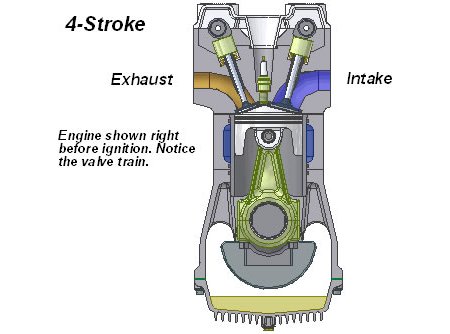
During the intake stroke, the piston goes down from the top of the cylinder to the bottom, reducing the pressure inside the cylinder. It then draws a mixture of fuel and air into the cylinder through the intake port, ready for the compression stroke.

With both intake and exhaust valves closed, the piston goes back up to the top of the cylinder compressing the fuel-air mixture. This is what happens during the compression stroke.

The compressed air–fuel mixture is then ignited by a spark. The pressure from the fuel-air mixture combustion drives the piston back down with humongous force, keeping the crankshaft turning. This is the power stroke phase, which is the main source of the engine's torque and power.

Finally, during the exhaust stroke, the piston again goes up and pushes the burned gas from the cylinder out the exhaust valve. Another thing worth mentioning is that the spark plug only fires once every two revolutions.

Two Stroke Engine


Two stroke engine
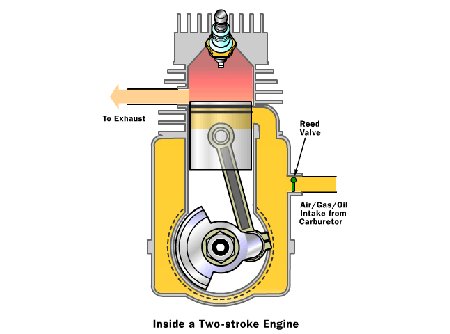
Unlike the four stroke one, a two stroke engine has three strokes combined into one action, meaning the intake and exhaust are both integrated into the compression movement of the piston, therefore eliminating the need for valves. This is thanks to an inlet and exhaust port integrated into the wall of the combustion chamber.

As the piston goes down from combustion, spent gasses are allowed to exit the chamber through the exhaust port. The air–fuel mixture is drawn through an inlet located lower in the chamber. As the piston rises again, it blocks off the inlet and exhaust ports, compressing the gasses at the top of the chamber. The spark plug fires and the process starts over. The engine fires on every revolution.

Let the fight begin!


A two stroke engine can produce twice the amount of power (and makes twice as much noise) than a four stroke engine of the same size. This is because it fires once every revolution, giving it twice the power of a four stroke, which only fires once every other revolution. Significantly, it also has a higher weight-to-power ratio because it is much lighter.

Two stroke engines are simpler and cheaper to manufacture compared to four stroke engines because of their simpler design. Four stroke engines are longer lasting than two stroke engines that don't have a dedicated lubricating system. However, the spark plugs in a two stroke engine last longer than those in a four stroke engine.

Four stroke engines are more fuel efficient and environmentally friendly when compared to two stroke engines that also create an unpleasant smell. Two stroke engines are responsible for much more pollution due to the combustion of oil.

Two stroke units may also exceed legal noise limits in some areas. That is why you should consider checking to see if any restrictions apply in your area before purchasing one.

KTM 390 DUKE

1. Will it run on standard fuel?

The science of it is that the higher the compression ratio on an engine, the more sensitive the engine becomes to the quality of the fuel. Bad fuel basically won’t ignite or burn as cleanly and eventually can cause pinging or detonation which slowly eats engines. 12.6:1 is considered a high ratio, though high performance production engines do go higher. However, KTM has run this kind of compression for a while now — the Duke 125 has a similarly high compression ratio — on Indian made platforms and it seems to work, at least in the markets the Duke 125 goes to.
We spoke to Bajaj and they told us that they have had a select group of customers running 390 Dukes on a closely monitored real use in the real world test – a standard process before most launches. And these customers have been using regular pump gas just like they would on their normal motorcycles with no reported problems so far.
The KTM 390 Duke will run just fine on regular unleaded fuel

2. Will it tour?

I spent roughly 240km in the saddle with one large break and several short breaks (to let slower riders catch up) and no one in our group, or indeed in any other group on our riding day in Salzburg complained. But let us look at it from the chassis and comfort side first. If you approach this question from the simple angle that the chassis and ergonomics are more or less the same as the Duke 200, then the answer is quite easy. You see, I’ve done a few 1000km days on the KTM 200 Duke over the last year and every time I’ve reached the same conclusions.
Mounting luggage on the 390 Duke can be a bit of bother
Firstly, mounting luggage on the Duke 390/200 is going to be a bother. The rear seat is pretty small and tail bags require unnecessary precision to mount so that they don’t impinge on your space. Two-up touring is impossible without significant mods creating space for luggage as well as for the pillion. I use a set of Kriega tail bags for which I created a rather simple set of nylon loops that mount where the grab rail would normally go that function as super-effective bungee points. The genius bit is that they lift off the paintwork when you use them, which makes them non-scratch.
Second, in terms of riding position, the Duke is cramped on long rides. This become more obvious if you’re going at a steady pace and then need to shift around in your seat. You will discover that unless you are Marc Marquez-sized there isn’t much squirming room. In my case, upping the pace solves this issue but it exists. The biggest ergonomics issue though is the footpeg position, which is a bit extreme and towards the end of the (thousand kilometre) riding day, I came to realise that the peg position is the biggest hindrance to touring rather than all the other niggles.
However, the upsides are also there. First, the seat might seem super-hard but it remains exactly the same for hours together and a numb bum isn’t a KTM attribute. Second, the seat does, over time, take the shape of your bum ever so subtly which makes riding long distances quite easy on the rear-end. Third, there is no buzz from the handlebars to speak of which means even with sustained high revs on the 200 (for example), buzzy hands isn’t a KTM attribute either.
The 390 Duke can tour comfortably as well as it can corner
The 390 Duke can tour alright, but not as well as it can corner
And finally, the KTM is extraordinary at holding on to its fuel economy even at stupidly high revs which means at a quick clip, more able touring motorcycles with bigger fuel tanks end up offering the same range as the KTM. Which is, oddly enough, a source of quiet satisfaction for the KTM rider. Actual range on the 200 between tankfuls (quarter tank to quarter tank) is about 225-240km and we expect the 390 to more or less exactly match or slightly exceed that figure. Yes, exceed. We believe the 390 will prove a little more frugal than the 200 in the real world because you’ll carry lower revs everywhere and the tall sixth will really be a boon to economy on the highway.
That brings us to the engine end of things. As I noted in my first ride story, 100kmph is 5,000rpm in sixth and 120kmph is 6,500rpm. These revs are quite comfortable for sustained highway work on the KTM and that alone changes the nature of the highway game for the KTM. The 200 was frantic and sustained 120kmph, apart from being illegal, was strenuous because it meant you had to sit at 8,500rpm or higher all the time. A few of us are mechanically insensitive enough to handle that kind of riding but most aren’t. The 390 solves that problem with its extra power and adds to its longer-legged feel (over the 200) with the the sixth gear ratio.
The KTM 390 is probably not going to be as comfortable a tourer as the Honda CBR250R. The Honda remains our current pick of the Indian touring motorcycle until we test and verify the 390 Duke on the highway. But, the 390 will be the bike offering both greater average speeds and average fuel economy on the open road. The CBR will have better ride quality and more space for the rider and luggage. But the KTM promises to be an extremely effective long-distance tool. This is a comparison test we at OVERDRIVE are looking forward to.

3. Can I ride two-up?

Of course. But please keep it to a minimum. Pillion space has always been at a premium on the KTM Duke and the 390 adds nothing to make things better. If you like wearing a backpack on the bike, you’ve more or less occupied all the space the pillion might have had. Overall, city trips should be okay but longer trips two-up are going to be hard on the pillion without a doubt.

4. What bits do I add to stock bike?

The KTM comes with comprehensive equipment but here is what we would add to the bike. We would throw away the metal crash guard and replace that with classier crash bungs. R&G sell theirs in India via Performance Racing Store. We have crash tested these and they work – but because they are imported they are expensive too. In our experience, the swingarm spool (aka cotton reels) and the radiator guards are must haves. Expect to pay about Rs 16-18,000 for the full set. Performance Racing also has protectors from another brand, Vortex.
On the Indian 390, handguards are part of standard equipment
A cheaper alternative is to order from jcMoto. jcMoto makes bar-end sliders and frame sliders (aka crash bungs). Again, we have crash tested these and can attest to their effectiveness. We do wish jcMoto would add fork sliders and swingarm spools to their line-up as well. The whole set should cost your about Rs 8,500 or so.
Tip: Remember that you have to loosen the top of the engine mounts to mount the plate the frame slider usually sits on. So double check that the bolts are torqued tight when you’ve finished mounting them.
Finally, KTM themselves also sell crash mushrooms although we have only ever found the front fork sliders (Rs 2200 approx, a year ago) in stock. Crash protection is a good place to start because though expensive, we know from experience that it does really work.
The only other thing we would add is to go to the 3M guys and get clear film protection for the painted and stickered bits. KTM skimps a little bit on cost by giving you stickers which are not protected by a clearcoat. A small investment in the 3M film goes a long way in making your bike look minty for longer. Again, we have tested the 3M film on our long-term Renault Duster and it does really work and is next to invisible.
Finally, do add a KTM powerpart or other scratch guard to the tank in the area where your belt or shirt buttons could scratch the tank.

5. What bits do I take off the stock bike?

Unless you regularly ferry your mom around, you can safely take off the saree guard. You can also take off the heavy splatter guard from the end of the swingarm quite easily. I like to add it back for the rains to ensure I don’t roost the heck out of people behind me. And since installation and removal requires basically four bolts to be added/removed, it’s an easy thing to do.

6. Do I really need this ABS stuff?

ABS, an absolute necessity on any vehicle is standard on the KTM 390 Duke
Yes. Undoubtedly yes. ABS or anti-lock brakes is a simple system in concept but its effectiveness in saving your skin cannot be understated. Even those of us who regularly practice braking and take motorcycles to full braking performance pretty often find it next to impossible to outperform ABS. And in wet or dusty conditions? ABS stops your bike quicker every single time.
In that sense, KTM offering ABS as standard on the 390 Duke is applause-worthy and other manufacturers really should take the step. In Europe, it will be soon be mandatory for motorcycles to offer standard ABS. And slowly but surely that day will come in India as well.
The way we see it, given how unpredictable our roads are, ABS shouldn’t be optional at all no matter what you’re buying. We would go so far as to say, spend whatever extra money you must and get an ABS-equipped motorcycle if you can.

7. Will it wade?

A lot of people wonder if the low-slung exhaust compromises the KTM’s ability to handle deep water. And simple answer is that most vehicles can wade until their engine intake or exhaust port (thumb rule) is submerged. And the KTM does not have an exceptionally lower intake or exhaust port so it should wade as well or as badly as any other Indian motorcycle.
The thing to remember is that deep water requires a certain nuance to cross safely. You should be able to keep the throttle evenly open the whole time so the exhaust (even if fully underwater) has enough pressure from the exhaust gases to prevent water from being sucked into the engine. So be careful and it will wade.

8. I hear the KTM 200 was super-hot to ride in traffic. The 390 will be as well?

Well, yes. The KTM 200 Duke didn’t really overheat in traffic but there is a problem there. The radiator fan, when it comes on, sucks hot air out of the radiator but pays no attention to where the hot air goes. And unfortunately, the engine splits the air into the two streams both of which end up on the rider’s legs. This is why the 200 Duke feels super-hot when you’re standing at a traffic light for instance. The 390 is likely to be the same.
On the other hand, remember this: higher performance means greater heat, a significant amount of which is wasted in all internal combustion engines. Which means that when you’re striving for higher performance, you’re going to have to learn to live with the heat – it isn’t really an option. Just ask any Indian superbike owners and they’ll tell you that the heat is the primary reason why commuting to work everyday on these beauties isn’t really all fun and games.
Short Stroke/Over square Engine: As the name signifies the Stroke is shorter than the Bore. Due to the relatively shorter stroke, the engine revs fast and is more suitable where a quick build of power is important, more importantly where the bikes make power at higher rpms.
Some examples:
  • RTR 180 (62.5mm X 57.8 mm) Bore x Stroke
  • Pulsar 220 (67mm X 62.4 mm), 180(63.5mm X 56.4mm) Bore x Stroke
Long Stroke/ Under square Engine: As the name suggests the Stroke is longer than the Bore. Due to the longer stroke, the engine makes good torque at relatively low rpms. It is important where the bikes’ pulling more (torque) at relatively low rpms is more important than the top speed.
Some examples:
  • Royal Enfield Classic 500 (84mm X 90mm), Classic 350 (70mm X 90 mm)
  • Hero Honda Karizma (65.5mm X 68.2mm)
The one exception to the above rule is the pocket rocket Yamaha R15 (57mm X 58.7mm) which is strange as R15 is a track oriented bike.
Square Engine: As a square has both the sides equal, here also the Bore and Stroke are of almost same size. The engine tries to strike a balance between torque and top speed
Some Examples:
  • Yamaha FZ-16 (58mm X 57.9mm)
  • Honda Unicorn (57.3mm X 57.8mm)
All these engines have their own advantages and disadvantages and it depends on the rider to decide what kind of motorcycle he/she needs.

STROKE

                                            STROKE


There were always some or the other terms that were mentioned but I never understood what it actually meant. And one such term was over square engine and its similar terms like under square engine. I never knew what it really meant, but I assumed it must be something related to the engine.
So, here I am, trying to write down what exactly these terms mean and by what way it benefits the rider. The engine size or capacity is generally the amount of the space the combustion chamber displaces and is measured in cc’s as we all are familiar with 220cc, 150cc engines mounted in various bikes.
The engine capacity is measured as Bore x Stroke. Here, Bore is the diameter of the cylindrical block and Stroke is the depth of the cylindrical block, as shown in the image.
The ratio of Bore and Stroke categorizes the engine. There are three different types of configuration available depending on the ratio